The First Ship Hit: What the Attack on the Tanker Skylight Tells Us About the New Reality in the Strait of Hormuz
- Team WAKE

- Mar 1
- 6 min read

First Ship Hit in Hormuz: The Tanker Skylight Attack Explained
On Sunday morning, the scenario shifted from theoretical to physical.
The Palau-flagged tanker Skylight was struck approximately five nautical miles north of Khasab Port, in Oman's Musandam Governorate, at the mouth of the Strait of Hormuz.
Oman's Maritime Security Centre confirmed the attack, reporting that all 20 crew members, 15 Indian nationals and five Iranians, were evacuated by the Omani navy.
Four sustained injuries of varying severity. Reports from Iran's semi-official Mehr News Agency later claimed the vessel was sinking after attempting what they described as an "unauthorised passage" through the strait.
It was the first attack on a commercial vessel in the Strait of Hormuz since the US and Israel launched coordinated strikes on Iran less than 48 hours earlier.
The Skylight is not a random casualty. Understanding what this ship is, who operates it, and why it was where it was tells a story about the collision of sanctions enforcement, shadow fleet logistics, and a region now in open conflict. All of it converging at the world's most important maritime chokepoint.
A Sanctioned Vessel in the Wrong Place at the Worst Time
The Skylight (IMO 9330020, MMSI 511101102) is a 2006-built chemical and oil products tanker of 11,622 deadweight tonnes. She was previously known as Al Moustafa before being acquired in June 2023 by entities linked to Hatem Elsaid Farid Ibrahim Sakr, an Egyptian businessman operating through UAE-based Red Sea Ship Management LLC and High Seas Petroleum LLC.
In December 2025, the US Treasury's Office of Foreign Assets Control (OFAC) sanctioned the Skylight, Red Sea Ship Management, and Sakr himself as part of a broad action targeting 29 vessels in Iran's so-called shadow fleet. Treasury described the vessel as an "enabler of Iranian petroleum exports," noting it had been used for ship-to-ship transfers of Iranian condensate in coordination with Sahara Thunder, a front company associated with Iran's Ministry of Defense.
Put plainly: the Skylight was already one of the most closely watched tankers in the Gulf before a single missile was fired this weekend.
That a US-sanctioned vessel, known to transport Iranian petroleum products, was struck while reportedly attempting to transit a strait that Iran's own Revolutionary Guard Corps had declared closed raises questions nobody can yet fully answer. Was the vessel targeted deliberately, or caught in the crossfire of a chaotic and rapidly escalating conflict? Iranian state media framed the attack as enforcement of their closure order. Bloomberg noted it was unclear who carried out the strike. The fog here is not metaphorical.
The Strait Has Not Closed. But It Has Effectively Shut Down.
Iran has never formally closed the Strait of Hormuz. Not in 1979, not during the Tanker War, and not today. But formal closure and functional shutdown are not the same thing.
Since the IRGC began broadcasting closure warnings on VHF Channel 16 on Saturday, the commercial response has been immediate and severe. Worldwide AIS Networks data showed a 70% drop in vessel traffic through the strait by Saturday evening.
Hapag-Lloyd suspended all transits. CMA CGM instructed vessels inside the Gulf to proceed to shelter. At least nine LNG carriers reversed course within a six-and-a-half-hour window on Saturday. Multiple VLCCs, including the partially loaded KHK Empress and India-flagged Desh Abhimaan, turned back.
Marine insurers have pulled war risk coverage for the area. Without insurance, vessels cannot legally sail. Without vessels sailing, a third of the world's seaborne crude oil supply is landlocked.
The Skylight attack did not cause this shutdown. But it is the incident that will feature in the first lines of every insurer's risk assessment, every underwriter's brief, and every commodity trader's Monday morning note. It makes the disruption tangible. A vessel is burning. Crew are in hospital. The abstract threat of Hormuz closure now has a name and an IMO number.
What AIS Data Shows, and What It Cannot
The Skylight was last broadcasting AIS data from a position in the Persian Gulf, listed as en route to Sharjah anchorage. Subsequent to the attack, reports described fire aboard the vessel off the coast of Oman's Musandam Peninsula.
But the broader AIS picture in the strait is fragmenting rapidly. Vessels are going dark for multiple, contradictory reasons. Some have switched off transponders to avoid being targeted, a practice the US Maritime Administration itself recommended for US-flagged ships in the Red Sea in 2024 to reduce Houthi attack risk. Others are experiencing GPS spoofing and electronic interference. Windward reported over 1,100 vessels affected by jamming in the past 24 hours alone, with ships falsely positioned over airports, a nuclear power plant, and on Iranian land.
This is not a clean data environment. It is the opposite.
For anyone trying to reconstruct what happened to the Skylight (when it entered the area, what its movements looked like in the days before the attack, whether it had been broadcasting consistently or going dark intermittently) the reliability of the underlying AIS data is everything. In a region where the major data providers have limited terrestrial receiver coverage, and where GPS spoofing can corrupt satellite feeds, the gaps in the picture are not academic. They are the difference between an informed reconstruction and a guess.
During the June 2025 strikes on Iran, AIS interference affected approximately 1,000 vessels per day near Iranian waters. The current operation is far larger in both scale and ambition. Electronic warfare across the Gulf should be treated as a baseline condition for the foreseeable future. The ability to cross-reference multiple independent data sources, verify signal provenance, and identify anomalous transmissions will separate useful intelligence from noise.
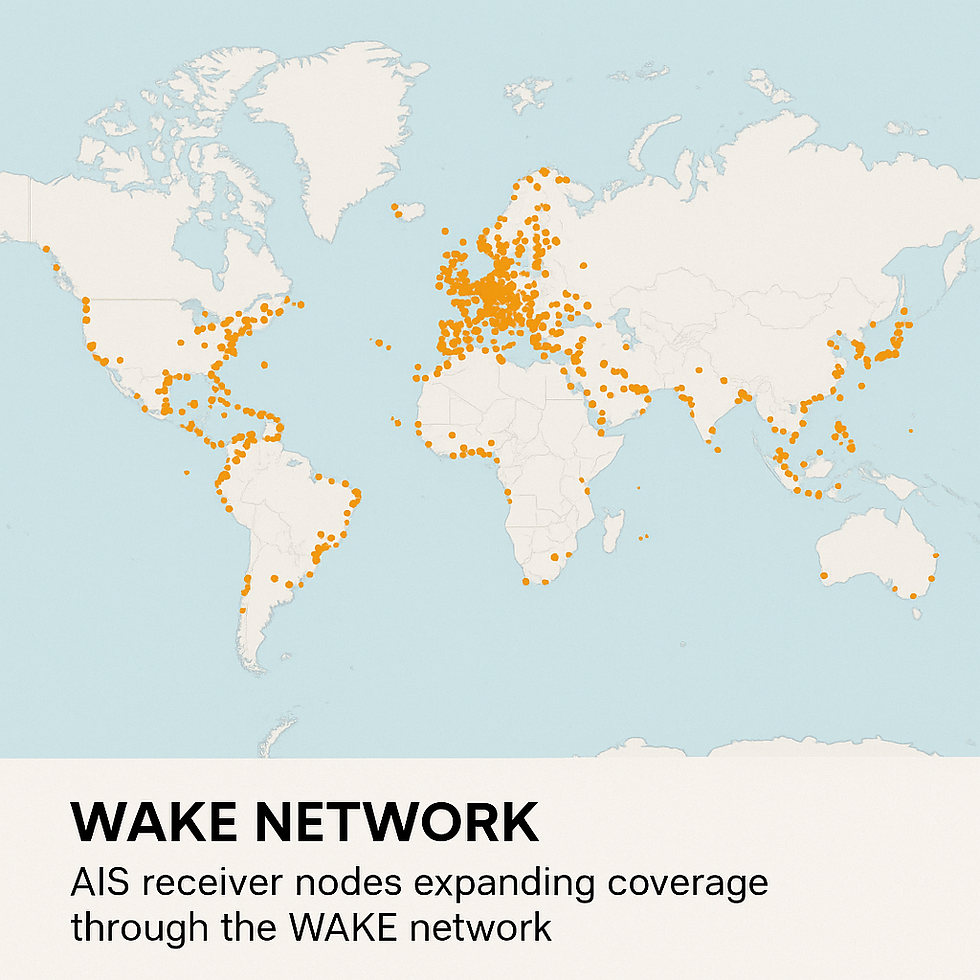
Decentralised AIS networks, those not reliant on a single provider's infrastructure or a single point of failure, offer a structural advantage in exactly this kind of environment. When one node is compromised or jammed, others continue to receive. When signals need to be verified, independent receipt from multiple receivers provides a chain of evidence that no single consolidated feed can replicate.
The Shadow Fleet Problem Just Got Worse
Before this weekend, the compliance challenge in the Gulf was already significant. Iran had been tripling oil exports in recent months, pre-positioning crude on tankers near Kharg Island ahead of what many intelligence analysts suspected would be a confrontation.
OFAC's December 2025 action against the Skylight and 28 other vessels was part of a maximum-pressure campaign to deny Iran petroleum revenue.
That pre-positioned oil is now somewhere in the system, on vessels that may or may not be broadcasting accurate identities and positions. The Skylight itself is a case study in the kind of vessel that compliance teams struggle to track: flagged in Palau, managed from the UAE, owned through a web of shell entities, sanctioned by Washington but operating in waters where enforcement is limited and the incentive to evade is existential.
Now add an active conflict, GPS jamming, and hundreds of vessels going dark simultaneously. The compliance picture has not merely degraded. It has become a fundamentally different problem.
For sanctions monitoring teams, insurers assessing exposure, and commodity traders trying to separate legitimate cargoes from sanctioned crude, the coming weeks will demand AIS data that does more than show a dot on a map. It will need to come with provenance. Verifiable, timestamped, and traceable to independent receivers.
What Comes Next
The Skylight is one ship. It is a small, sanctioned tanker that most people had never heard of 24 hours ago. But it is also the first physical casualty of what could become the most significant maritime disruption in four decades.
Whether the Strait of Hormuz reopens to commercial traffic in days or remains functionally closed for weeks depends on decisions being made in Tehran, Washington, and insurance boardrooms in London right now. The IRGC has since announced the strait is open "until further notice," while simultaneously declaring all US military personnel and assets in the region legitimate targets. Hapag-Lloyd, CMA CGM, and most major operators have not resumed transits.
Approximately 750 commercial vessels were inside the strait area when the conflict began. Over 100 container ships, 450 oil and gas tankers, and 200 bulk carriers remain somewhere in those waters. Each of them is a data point. Each of them is somebody's cargo, somebody's insurance policy, somebody's supply chain.
Tracking them accurately, not approximately, not intermittently, but verifiably, is the problem that everyone from Lloyd's to CENTCOM is trying to solve right now.
The Skylight is burning off Musandam. The data picture should not be.
Worldwide AIS Network operates a decentralised, blockchain-verified AIS data network providing maritime intelligence firms, insurers, commodity traders, government agencies, and compliance professionals with high-integrity vessel tracking data. To discuss your data requirements or request a pilot, visit worldwideais.org or contact us directly.
All events referenced in this article reflect reporting as of 1 March 2026. The situation is developing rapidly.


Comments