Spire Maritime & Kpler Alternatives: Why Your Next AIS Data Provider Needs Provenance Built In
- Team WAKE

- Feb 25
- 12 min read
A practical guide for data buyers navigating the post-consolidation AIS market — and why switching vendors without upgrading your trust model is a missed opportunity.
Published February 2026 | Reading time: 12 minutes

Spire Maritime Alternatives That Go Beyond a Like-for-Like Data Swap
If you are reading this, there is a good chance you already know the story. In November 2024, Kpler acquired Spire Maritime for $241 million. By September 2025, Spire’s satellite AIS feeds, MarineTraffic’s 13,000-station terrestrial network, and FleetMon had all been unified under a single “Kpler AIS” brand. Separately, S&P Global acquired ORBCOMM’s AIS business. In under two years, the AIS data market went from a multi-vendor ecosystem to a near-duopoly.

If you were sourcing AIS data from Spire, from MarineTraffic, or from ORBCOMM, your vendor relationship has fundamentally changed. Your contract terms may have already been renegotiated. Your pricing may have shifted. The independent provider you chose specifically because they were independent is no longer independent.
Naturally, you are looking for alternatives. But before you sign with the next name on a vendor list, consider what this disruption actually revealed. It is not just that your provider was acquired. It is that your entire data pipeline had no provenance layer, no immutable audit trail, and no way to independently verify that the AIS data you were paying for had not been altered, fabricated, or spoofed.
Switching to another centralised provider solves the vendor dependency problem temporarily. It does not touch the data trust problem. And in a market where AIS manipulation is rising in both frequency and sophistication, the trust problem is the one that will define your next procurement decision.
This article is for data buyers who want more than a replacement feed. It is for those who see this market disruption as the catalyst to upgrade from commodity AIS data to something fundamentally more trustworthy — at a lower cost.
The Problem With Like-for-Like Replacement
The instinct when you lose a data provider is to find the closest equivalent. Same coverage footprint, same refresh rate, same API format, different logo on the invoice. This is understandable. It is also incomplete.
Most AIS data providers, including the ones that have been acquired and the ones that remain independent, operate on the same fundamental model: receive AIS signals, aggregate them, and distribute position data with timestamps to customers. That is the entire product. A latitude, a longitude, a vessel identifier, and a time.
What is missing from standard AIS data
What this model does not provide is any of the following:
Which specific receiving station captured the signal. Without this, you cannot independently verify that the data originated from a physical receiver in a location consistent with the reported vessel position.
What the signal characteristics were at reception. Signal strength, antenna gain, noise floor, and environmental conditions provide forensic context that determines whether a received position is physically plausible.
Whether the data has been altered between collection and delivery. Without an immutable record, there is no way to confirm that the AIS positions you receive are identical to what was originally captured by the receiving station.
A chain of custody that a compliance team or regulator can audit. In sanctions enforcement, emissions reporting, and insurance claims, “we got this data from our AIS provider” is increasingly insufficient. Regulators and underwriters want to see how you know the data is authentic.
The core issue: most AIS data is treated as a commodity. But commodities do not require trust. AIS data, in a world of rising spoofing and tightening regulatory scrutiny, absolutely does.
The Rising Cost of Unverified AIS Data
The argument for data traceability is not theoretical. AIS manipulation is a documented, growing, and increasingly sophisticated problem with direct financial and legal consequences for organisations that rely on unverified data.
AIS spoofing is no longer an edge case
AIS spoofing — the deliberate broadcast of false vessel positions — has moved from a niche concern to a mainstream operational risk. Vessels routinely manipulate their AIS signals to conceal port calls in sanctioned jurisdictions, fabricate compliance-friendly routes, mask ship-to-ship transfers, and obscure true destinations for cargo currently under trade restrictions.
The techniques are becoming more sophisticated. Early spoofing involved simply turning off AIS transponders (creating “dark” periods). Current methods include broadcasting fabricated position tracks that appear normal to automated systems, identity hijacking where multiple vessels broadcast the same MMSI number, and coordinated spoofing where multiple vessels simultaneously alter their positions to create false traffic patterns.
The compliance exposure is real
For organisations in sanctions compliance, the consequences of acting on spoofed AIS data are severe. Banks, insurers, commodity traders, and shipping companies face regulatory penalties, reputational damage, and criminal liability if they facilitate sanctioned transactions based on AIS data they cannot prove is authentic.
The critical question that regulators and counterparties are increasingly asking is not “what did the AIS data show?” but “how do you know the AIS data is trustworthy?”
If your answer is “we received it from our data provider and assumed it was accurate,” that answer is becoming legally and commercially insufficient.
Real-world spoofing scenarios: standard vs. traceable data
The following table illustrates how standard AIS data and traceable AIS data respond differently to three common spoofing scenarios:
Spoofing Scenario | Standard AIS Provider Response | Worldwide AIS Network Response |
Vessel reports position 200nm from actual location | Data accepted and distributed. Anomaly detection, if any, is retroactive and opaque. | Station metadata flags inconsistent signal strength for reported distance. Blockchain record preserves both original and corrected data for audit. |
Vessel turns off AIS in sanctioned waters, then re-enables with fabricated track | Gap noted but fabricated track accepted at face value. No provenance data to challenge it. | Receiving stations provide metadata showing no signal received during gap period. Fabricated positions lack corresponding station metadata, flagging manipulation. |
Multiple vessels broadcast identical MMSI (identity hijacking) | Conflicting positions create data noise. Typically resolved by discarding duplicates with no forensic record. | Station-level metadata shows simultaneous signals from different geographic locations with different signal characteristics, identifying the spoof with auditable evidence. |
In every scenario, the difference between standard and traceable data is the difference between accepting manipulated information at face value and having the forensic tools to challenge it with auditable evidence.
What Data Traceability Actually Means: Three Layers of Trust
The term “data quality” is used broadly and often vaguely across the maritime data industry. Every provider claims high-quality data. Very few define what that means in terms of verifiable, auditable trust. The Worldwide AIS Network’s approach is built on three distinct, independently valuable layers that together create something no other AIS data provider currently offers: a complete, immutable chain of custody from receiving antenna to customer delivery.

Layer 1: Verification — Is This Signal Authentic?
Verification happens at the point of ingestion. When an AIS signal reaches a Worldwide AIS Network receiving station, it is not simply forwarded into a data pipeline. The signal undergoes authentication checks against known vessel databases, consistency validation against physical plausibility (is this signal strength consistent with the reported vessel position?), and cross-referencing against nearby station observations where coverage overlaps.
The result is that data entering the network has been actively verified, not passively accepted. Signals that fail verification are flagged, not discarded — they remain available for forensic analysis but are clearly marked as unverified, giving downstream users the context to make informed decisions rather than unknowingly acting on suspect data.
Layer 2: Traceability — Where Did This Data Come From?
Every AIS message processed through the Worldwide AIS Network carries a rich metadata package from the receiving station. This is not just a station ID. It includes signal strength at reception, antenna characteristics, noise floor measurements, environmental conditions, and precise timestamps, the complete physical context of how and where the signal was captured.
This metadata serves two purposes. First, it enables significantly more effective data cleaning. Anomalous signal characteristics can identify faulty equipment, atmospheric interference, or deliberate manipulation that position-only data would miss. Second, it provides the forensic foundation for spoofing detection. A vessel claiming to be 50 nautical miles from a coastal station but received with signal strength consistent with 5 nautical miles generates a metadata flag that raw position data alone would never reveal.
For the data buyer, traceability means you can answer a question that no other AIS data provider enables: “Show me the physical evidence that this specific data point originated from a real signal received by a real station at a specific time and place.”
Layer 3: Immutability — Can Anyone Alter the Record?
Verification and traceability are valuable. But they are only fully trustworthy if the records themselves cannot be tampered with after the fact. This is where blockchain-backed immutability completes the trust architecture.
The Worldwide AIS Network records data provenance on-chain. Once an AIS message has been received, verified, and enriched with station metadata, its provenance record — including the verification result, station identity, and metadata digest — is written to an immutable ledger. This record cannot be altered, deleted, or retroactively modified by anyone: not by the station operator, not by the network, and not by the data customer.
This creates something that does not exist anywhere else in the AIS data market: an independently auditable, tamper-proof chain of custody for maritime vessel tracking data.
For compliance teams, this is transformative. Instead of relying on a data provider’s assurance that their data is accurate, you can present a blockchain-verified provenance record showing exactly where each data point originated, how it was verified, and that it has not been modified since collection. This is the difference between “our provider says the data is good” and “here is the cryptographic proof.”

How These Layers Compare Across Providers
The following table shows how the Worldwide AIS Network’s three-layer trust architecture compares to standard AIS providers and the consolidated players:
Capability | Typical AIS Provider | Kpler / S&P Global | Worldwide AIS Network |
Signal Verification | None — raw ingestion | Internal QA (opaque) | Verified at ingestion |
Data Provenance | Not tracked | Internal only | Blockchain-recorded |
Immutable Audit Trail | No | No | Yes — on-chain |
Station Metadata | Not provided | Limited / not exposed | Full (signal strength, antenna, environment) |
Spoofing Detection Layer | None | Proprietary (not auditable) | Metadata-enabled, auditable |
End-to-End Traceability | Receiver → Customer: No chain | Internal systems only | Receiver → Blockchain → Customer: Full chain |
Compliance Evidence Package | Not available | By request, limited | Built-in: exportable proof of data origin |
The gap is structural, not incremental. Other providers can improve their data quality processes. What they cannot easily replicate is the combination of station-level metadata, blockchain-backed immutability, and a decentralised infrastructure model that eliminates the conflicts of interest inherent in vertically integrated data companies.
The DePIN Cost Advantage: Better Data, Lower Price
The trust architecture described above would be compelling at any price. But the Worldwide AIS Network’s Decentralised Physical Infrastructure Network (DePIN) model delivers an additional, equally significant advantage: structurally lower data costs for buyers.
Why centralised AIS data is getting more expensive
The economics of centralised AIS data provision are straightforward, and they work against the buyer in a consolidating market. Kpler spent $241 million acquiring Spire Maritime’s satellite constellation. It acquired MarineTraffic and FleetMon at undisclosed but significant valuations. S&P Global acquired ORBCOMM’s AIS division. These acquisition costs do not disappear. They are amortised across the customer base through data pricing.
In addition, centralised providers bear the full operational cost of maintaining their infrastructure: satellite constellation management, ground station maintenance, hardware refresh cycles, spectrum licensing, and the engineering teams to support all of it. These are capital-intensive operations, and with fewer competitors in the market to create price tension, there is increasing latitude to pass costs through to customers.
The result is predictable: post-consolidation AIS data pricing is rising, and the trend is structural, not cyclical.
How DePIN inverts the cost structure
The DePIN model distributes infrastructure ownership and maintenance costs across a network of independent contributors. Station operators own and maintain their equipment. They are incentivised to participate through contributor rewards, not through corporate salary structures. The network does not need to acquire other companies to grow its coverage footprint — it grows organically as contributors join.
This eliminates three of the largest cost drivers in centralised AIS data:
No acquisition premiums. The Worldwide AIS Network has not spent hundreds of millions acquiring other data companies. There is no M&A debt to service and no acquisition premium to amortise through customer pricing.
No centralised infrastructure CapEx. Contributors provide the physical infrastructure. The network does not own satellites or thousands of proprietary ground stations. Capital expenditure is distributed, not concentrated.
No pricing power incentive. A decentralised network does not benefit from reducing competition. Its economic model is based on growing the contributor base and data volume, not on maximising per-customer pricing.

The cost comparison
Cost Component | Centralised Model (Kpler, S&P) | DePIN Model (Worldwide AIS) |
Infrastructure CapEx | $241M+ acquisition costs amortised across customer base | Distributed across contributors — no centralised CapEx |
Satellite Constellation | $100M+ to build, maintain, and replace satellites | Terrestrial-first model: no satellite CapEx burden |
Station Maintenance | Centralised OpEx for 13,000+ company-owned stations | Contributor-maintained: costs stay with station operators |
Acquisition Premium Pass-Through | Yes — M&A costs ultimately reflected in data pricing | No acquisitions — no premium to recover |
Pricing Leverage | Increasing — fewer competitors to create price tension | Structurally lower — decentralised economics cap costs |
Data Pricing to Customer | Rising post-consolidation; quote-only, opaque | Significantly lower; transparent pricing |
The bottom line for data buyers: the Worldwide AIS Network delivers verifiably higher data integrity — with blockchain provenance, station metadata, and spoofing detection — at a structurally lower cost than consolidated providers. This is not discounted pricing. It is a fundamentally different economic model where the cost savings are inherent in the architecture, not dependent on a temporary promotional offer.
What this means for your AIS data budget
For organisations currently evaluating Spire Maritime alternatives or Kpler alternatives, the DePIN cost advantage changes the procurement calculus significantly. You are not choosing between equivalent data at different prices. You are choosing between commodity position data from a consolidating duopoly with rising costs and limited transparency, and verified, traceable, immutable AIS data from a decentralised network with structurally lower costs and full provenance.
The cost savings are not marginal. Because the Worldwide AIS Network’s operating model eliminates the three largest cost drivers in centralised AIS data (acquisition premiums, infrastructure CapEx, and consolidation-driven pricing power), data buyers can expect meaningfully lower per-message or per-vessel pricing compared to the post-consolidation rates offered by Kpler AIS or S&P Global’s maritime data services.
Who Benefits Most: Use Cases for Traceable AIS Data
While every AIS data buyer benefits from improved data integrity, four segments stand to gain the most from the Worldwide AIS Network’s trust architecture.
Sanctions compliance teams
Sanctions enforcement increasingly requires proving that due diligence was conducted using trustworthy data sources. Blockchain-backed provenance transforms AIS data from an input that must be defended to an evidence package that defends itself. Compliance teams candemonstrate to regulators that vessel positions were independently verified, fully traceable, and stored in an immutable record — significantly strengthening their legal and regulatory position.
Marine insurance underwriters
Insurance claims involving vessel movements (groundings, collisions, cargo discrepancies, deviation from declared routes) frequently depend on AIS data as evidence. When that data comes with a complete, auditable chain of custody, the underwriter’s ability to validate or challenge a claim improves dramatically. Station-level metadata provides forensic detail that position-only data cannot.
Emissions monitoring and ESG reporting
As IMO regulations tighten and carbon intensity indicators become standard reporting requirements, the accuracy and verifiability of vessel movement data directly impacts emissions calculations. Traceable AIS data with immutable records ensures that the underlying position data feeding emissions models is auditable and defensible — a requirement that will only intensify as ESG reporting standards mature.
Maritime analytics startups and SaaS companies
Companies building products on top of AIS data have the most to gain from both the trust and cost advantages. The DePIN model’s lower pricing reduces their cost of goods sold, improving unit economics. The provenance layer becomes a competitive feature they can pass through to their own customers: “Our analytics are built on verified, blockchain-traceable AIS data.” In a market where data integrity is becoming a differentiator, this is a positioning advantage that costs nothing additional to communicate.
A Decision Framework: Choosing Your Next AIS Data Provider
For data buyers currently evaluating alternatives, the following framework organises the decision around the factors that matter most in the post-consolidation landscape.
Step 1: Audit your current exposure
Identify every AIS data source in your pipeline. Determine which are now owned by Kpler (MarineTraffic, FleetMon, Spire Maritime) or S&P Global (ORBCOMM). Assess whether your contract terms have changed or are due for renewal within 12 months.
Step 2: Define your trust requirements
Ask your compliance, legal, and product teams: if a regulator or counterparty asked you to prove the provenance of the AIS data underlying a specific decision, could you do it today? If the answer is no, data traceability is not optional — it is a gap in your operational risk framework.
Step 3: Evaluate the cost trajectory
Compare your current per-message or per-vessel AIS data costs against your contract from two years ago. If costs have risen — and for most buyers of Kpler or S&P Global data, they have — project the trajectory forward in a market with less competition and more pricing power. Then compare against the Worldwide AIS Network’s DePIN-enabled pricing.
Step 4: Build for redundancy
The lesson of 2023–2025 is that any centralised provider can be acquired. Even if you choose to maintain a relationship with a consolidated provider for their coverage breadth, adding an independent, structurally acquisition-proof data source like the Worldwide AIS Network ensures your pipeline has resilience that single-vendor dependency cannot provide.
Step 5: Evaluate the evidence, not the branding
Large providers have strong brands and long track records. But branding is not a substitute for verifiable data integrity. Ask every provider on your shortlist the same question: “Can you provide me with an immutable, independently auditable provenance record for every data point you deliver?” Today, only one provider can answer yes.
Don’t Just Replace Your Provider. Upgrade Your Trust Model.
Your search for a Spire Maritime alternative or a Kpler alternative is the right instinct. The consolidation of the AIS data market has created real risks around pricing, access, and vendor dependency that prudent data buyers should mitigate.
But the smartest response to this disruption is not finding the same data from a different pipe. It is recognising that the disruption exposed a deeper problem — the absence of verifiable trust in AIS data — and using this moment as the catalyst to solve it.
The Worldwide AIS Network offers something that no other AIS data provider currently can: a three-layer trust architecture combining signal verification, blockchain-backed provenance, and station-level metadata enrichment. Its DePIN infrastructure model delivers this at structurally lower costs than consolidated providers burdened with acquisition debt and centralised CapEx.
For data buyers, the choice is increasingly clear. You can switch from one centralised provider to another and hope that the next one is not acquired. Or you can upgrade to a data model where trust is built in, not bolted on, and where the economics work in your favour by design.
The AIS data market has changed. Your approach to sourcing it should change with it.
About Worldwide AIS Network
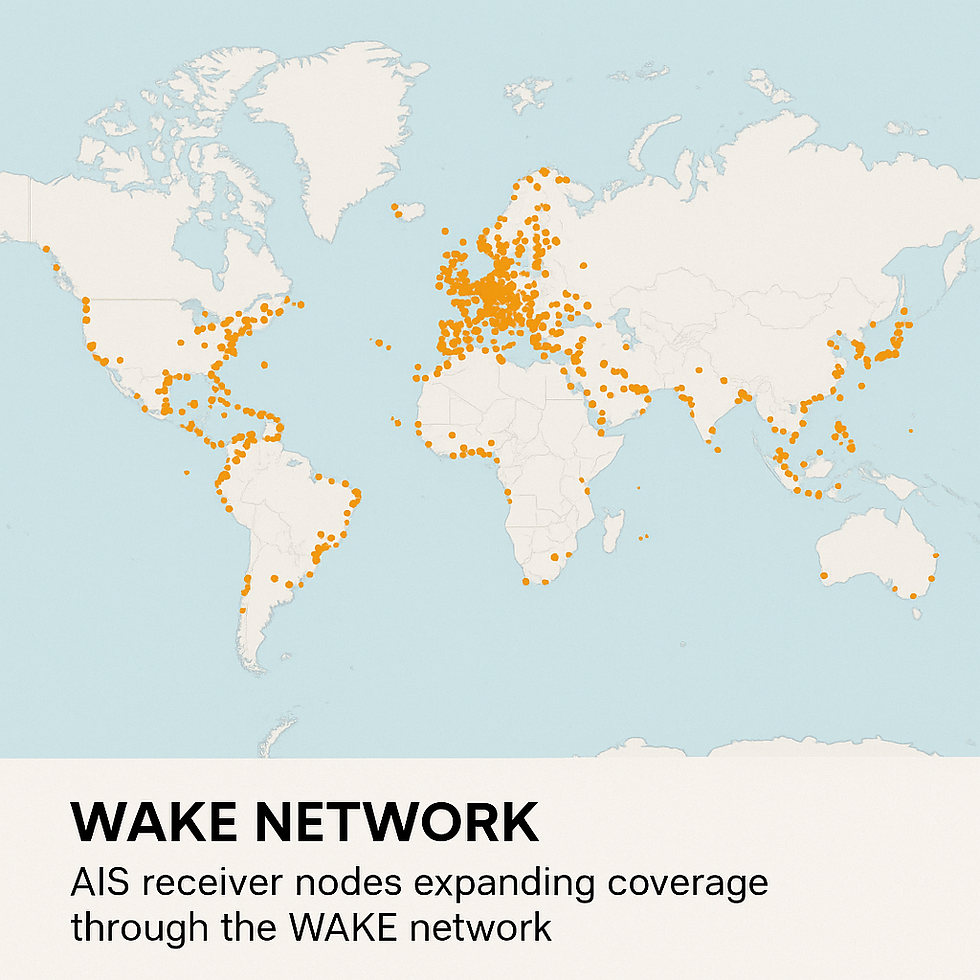
Worldwide AIS Network provides verified, blockchain-traceable AIS data through an extensive independent terrestrial receiver network with station-level metadata enrichment for advanced data cleaning and spoofing detection. Its DePIN infrastructure model enables enterprise-grade maritime data at structurally lower costs than consolidated providers.
To learn more about data services, pricing, and integration, visit worldwideais.org.


Comments