Verified AIS Data: How Worldwide AIS Network ApS and MastChain Make Provenance and Integrity Auditable at Scale
- Team WAKE

- Feb 1
- 10 min read

Global maritime operations have quietly become software-defined. Everything from port ETA prediction to sanctions screening, fleet performance benchmarking, insurance exposure modeling, and maritime domain awareness pipelines depends on a continuous stream of AIS positions and associated voyage context. The market has therefore shifted from simply “having AIS” to demanding Verified AIS Data: data that can be traced back to an original reception event, with integrity controls strong enough to withstand audits, disputes, and adversarial conditions.
That evolution is driven by a simple reality: AIS is an open VHF broadcast designed for safety and coordination, not for evidentiary-grade telemetry. Shore networks, cloud processing chains, and vendor enrichment layers transform that broadcast into enterprise datasets. But every transformation introduces questions that traditional AIS vendors often struggle to answer in a provable way:
Where did this message originate, specifically?
Was it altered, normalized, de-duplicated, or reconstructed?
Can an independent party verify the lineage without relying on vendor assurances?
Worldwide AIS Network and its blockchain, MastChain are emerging as a notable response to those questions, using cryptographic provenance to make AIS data integrity and traceability measurable rather than assumed. Their approach matters because it addresses a core procurement pain point for enterprise data buyers: reducing buyer risk when AIS underpins high-stakes decisions.
The Hidden Crisis in AIS Data Quality
AIS has become indispensable, but its weaknesses are well documented. The gap between operational reliance and technical trust is where risk accumulates.
Spoofing and manipulation are operational, not theoretical
AIS messages can be fabricated, replayed, or manipulated because the protocol was not designed with built-in integrity verification. Academic literature highlights that AIS transmissions are not inherently protected by cryptographic integrity checks, and messages may be jammed or intentionally spoofed.
On the commercial side, risk and compliance providers treat spoofing as a practical indicator of sanctions exposure and deceptive shipping behavior, because falsified tracks can create plausible deniability around port calls and voyage paths.
Coverage gaps and “dark” behavior distort analytics
Even perfect integrity controls cannot solve absence of signal. It is widely reported that a meaningful portion of vessels may emit no AIS signal in certain contexts, creating “dark” segments that analytics teams must model around. A Danish technical university news item referencing 2024 research in Nature notes findings that up to 30% of vessels emit no AIS signal.
This matters commercially because many downstream products—risk scoring, trade flow estimates, berth optimization, implicitly treat AIS as a near-continuous telemetry layer. When gaps coincide with high-risk geographies, the cost of incorrect inference rises sharply.
Vendor opacity and the missing link: source traceability
Most enterprise buyers accept that AIS is noisy. The bigger problem is when AIS data provenance cannot be demonstrated:
Data is aggregated from multiple third-party receivers and partner feeds.
Enrichment and deduplication may be applied, but without auditable lineage.
Customers must accept trust-based sourcing claims because they cannot independently verify the origin of a specific message or track segment.
Some platforms expose a “source” field (terrestrial vs satellite) in API responses, which is useful, but it still does not prove that a specific record is unmodified from reception through storage and delivery.
This is the trust gap Worldwide AIS is explicitly targeting: moving from vendor assurances to verifiable evidence.
Why Blockchain Has Historically Failed in Data Infrastructure
The maritime sector has seen multiple attempts to apply distributed ledger concepts to data exchange and traceability. Many pilots did not reach production scale, especially where high-velocity telemetry is involved.
Hype collided with physics: throughput, cost, and storage
A common failure mode is attempting to store large data volumes on-chain. High-frequency systems generate more events than most ledgers can economically store in raw form. Maritime-focused research and government primers frequently point to scalability constraints and performance/cost trade-offs for high-volume data use cases.
The oracle problem never went away
Even if a ledger is immutable, it cannot natively verify that an incoming “real-world” data point is genuine. External systems must feed data into the ledger, which shifts trust to the ingestion layer (the “oracle” challenge). The U.S. Maritime Administration primer describes how ledgers cannot pull external data directly and rely on oracles for real-world inputs.
Why MastChain is different in principle
The differentiator is not a promise of universal truth. It is architectural restraint:
Don’t put AIS payloads on-chain.
Put cryptographic commitments (hashes, timestamps, and provenance metadata) on a ledger.
Keep raw AIS in scalable cloud object storage.
Make verification possible for the buyer, record by record.
That is the pattern that tends to survive production realities: using a ledger for integrity proofs and audit trails, not as a primary data lake.
Worldwide AIS Network ApS: Redefining AIS Infrastructure
Worldwide AIS Network positions itself not as a pure data reseller, but as an infrastructure-led operator building an independent collection and verification layer for maritime intelligence. Its public messaging emphasizes verification, traceability, and an alternative to opaque maritime data markets.
This distinction matters for enterprise buyers because first-party collection changes the trust equation. A reseller can improve processing, but provenance ultimately depends on upstream partners. A network operator can design provenance into collection, validation, and storage from the start.
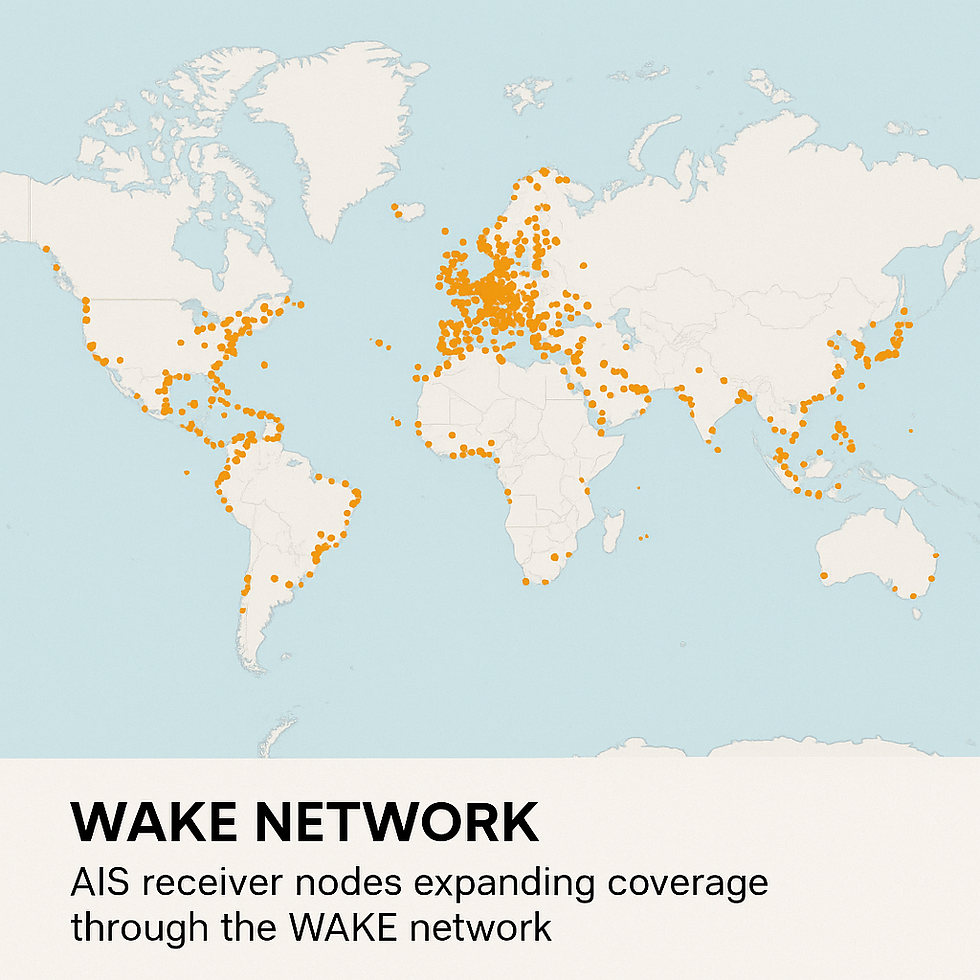
In practical terms, Worldwide AIS describes a distributed receiver network where each message passes through integrity checks before entering the stream.
What Is MastChain?
MastChain can be understood as a provenance system for AIS events that produces tamper-evident records without trying to “be” the data pipeline itself.
In simple but technical terms, the system centers on:
Blockchain-secured AIS metadata (not the AIS message itself)
When an AIS message is received by a station, MastChain generates metadata describing the reception event and creates a cryptographic hash commitment that represents the message (or a canonical representation of it). That commitment is written to a ledger, creating an immutable AIS data audit artifact tied to time and source context.
Immutable event records and timestamping
By anchoring reception metadata and hash commitments to a ledger, MastChain produces a record that is resistant to retroactive alteration. The operational implication is not “perfect truth,” but non-repudiation of what was ingested and when—assuming the ingestion point is controlled and auditable.
A provenance ledger linked to cloud storage
Raw AIS payloads are stored in conventional cloud infrastructure for performance and cost reasons, while the ledger stores the verification layer. This is the key to making “blockchain AIS data” practical: the ledger proves integrity and sequence; the cloud delivers throughput.
MastChain’s own materials describe layered validation checks (geographic plausibility, timing accuracy, radio integrity) before accepting a message, and note testnet deployment within the PEAQ ecosystem on Polkadot.
How MastChain Works (Step-by-Step Flow)
A buyer evaluating trusted AIS data usually wants an end-to-end explanation that maps to procurement and audit questions. The flow can be summarized as follows:
AIS message received
A terrestrial receiver station captures an AIS broadcast.
Metadata generated
The system generates reception metadata (e.g., station identity, timestamp, basic message descriptors, validation flags).
Hashed and written to a ledger
A cryptographic hash representing the message (or canonical form) plus relevant metadata is committed to the ledger as a tamper-evident record.
Raw message stored in cloud
The AIS payload is stored in scalable object storage (optimized for query, replay, and bulk extraction).
Hash reference links ledger to cloud object
The ledger record includes a reference to the stored object (or to a content address / object identifier), enabling a verifiable link between “what was stored” and “what was anchored.”
Customer verifies provenance
A customer can hash the received payload (or canonical form), compare it to the on-ledger commitment, and confirm whether the record matches the original anchored event—independently of vendor assurances.
Why Immutable Provenance Changes AIS Data Economics.
Data buyers do not pay premiums for technology choices. They pay premiums for reduced risk, reduced friction, and increased defensibility of outputs. Immutable provenance changes those economics in several ways.
Auditability becomes a product feature
When data lineage can be demonstrated, teams can support:
Internal model governance reviews
Regulatory inquiries
Customer disputes over analytics outputs
Security and intelligence evidentiary workflows
Non-repudiation reduces contractual ambiguity
In many AIS contracts, buyers accept “best efforts” language around coverage and quality, because disputes are hard to resolve. Provenance creates the possibility of contracting on verifiable attributes:
confirmed ingestion time windows
demonstrable source type and station identity
integrity-verified record delivery
Regulatory confidence and lower buyer risk
When AIS is used for compliance screening (sanctions, ESG reporting, environmental monitoring), provenance lowers the risk that an organization cannot defend how it reached a conclusion. This is especially relevant where AIS manipulation is known to occur in contested theaters.
Higher-value datasets and premium-grade products
Provenance is not a replacement for quality controls. It is the layer that allows quality controls to be trusted and audited. In practice, it enables product tiers such as:
integrity-verified historical AIS archives
compliance-grade movement datasets
forensic replay packages with verifiable chain-of-custody
Real-World Use Cases for Blockchain-Verified AIS Data
The value of verification depends on the use case. The common theme is not “better maps,” but better defensibility.
Defense and maritime security
Security organizations care about chain-of-custody and the ability to justify analytic outputs. AIS has known spoofing and falsification risks, including documented cases where tracks were fabricated to create disinformation effects.
What verification enables:
Distinguishing “vendor-reconstructed” tracks from ingestion-anchored events
Preserving auditable timelines for alerts and incident reports
Supporting data fusion workflows where AIS is cross-validated with radar, imagery, or SIGINT-derived indicators
Insurance and risk analytics
Insurers and risk modelers depend on AIS-derived behavior features (port calls, route adherence, loitering patterns). Spoofing and “going dark” can materially affect risk scoring and claims investigations.
What verification enables:
Defensible event histories for disputes and claims reviews
Reduced model contamination from injected or altered AIS events
Better governance for data lineage in regulated actuarial workflows
Commodity trading and market intelligence
Traders use AIS for trade flow inference and shipment monitoring. The cost of false positives is real: it can trigger incorrect supply assumptions, mispriced positions, or flawed congestion models.
What verification enables:
Higher confidence in time-critical signals (arrivals, departures, anchorage patterns)
Better separation between raw AIS facts and enriched interpretations
Stronger defensibility when AIS-driven insights are shared with counterparties or internal risk committees
Port optimization and operational planning
Ports, terminals, and marine service providers increasingly operationalize AIS for berth planning and arrival management. Here, provenance supports operational reliability and accountability.
What verification enables:
Improved post-incident reviews (what data was available at the time decisions were made)
Better vendor management through verifiable service-level attributes
Traceable data inputs for machine learning models used in ETA and congestion forecasting
ESG and compliance
Environmental and compliance monitoring increasingly depends on movement and behavior evidence. Academic and industry work highlights challenges around fabricated or untrustworthy maritime data in compliance contexts.
What verification enables:
Audit-ready movement histories supporting ESG disclosures
Stronger evidentiary posture when reporting is challenged
Clearer separation between “observed AIS” and “inferred activity”
Research and historical analysis
Researchers need reproducibility. When datasets are reprocessed or updated without traceable lineage, longitudinal studies become difficult to reproduce.
What verification enables:
Stable citations of data slices with integrity proofs
Transparent dataset evolution over time
Better institutional trust in shared archives and derived indicators
Worldwide AIS vs Traditional AIS Vendors
The competitive wedge is not that other providers lack quality controls. Many do. The wedge is whether those controls—and the underlying sourcing—can be independently verified.
A simple comparison narrative:
Traditional AIS vendors | Worldwide AIS Network |
Opaque sourcing and aggregation layers | Full provenance focus with verifiable records |
No cryptographic integrity proof to the buyer | Ledger-anchored verification layer described as message-level validation and accountability |
Data often resold from partners | Positioned as infrastructure-led, building independent receiver-based collection |
Trust-based dispute resolution | Math-based verification possible record-by-record |
Enterprise buyers should treat these as evaluative questions rather than marketing claims:
Can a specific record be traced to a specific reception event?
Can integrity be verified independently?
Is the provider operating first-party infrastructure or primarily aggregating?
Why Data Buyers Should Care
For enterprise procurement teams, verification is not ideology. It is cost control.
Reduced due diligence and faster onboarding
When provenance is auditable, buyers can streamline:
source validation
security reviews focused on integrity controls
governance documentation for model risk management
Stronger customer trust in downstream products
Maritime analytics firms selling derived intelligence often face skeptical customers when conclusions conflict with other datasets. Being able to say “this segment is integrity-verified” improves confidence without overstating certainty.
Differentiated analytics products
Verification supports premium SKUs such as:
compliance-grade movement feeds
forensic-grade historical extracts
audit-ready anomaly datasets
Lower legal and reputational risk
If AIS-driven outputs influence enforcement decisions, sanctions screening, or high-value claims, provenance reduces the risk of basing conclusions on falsified inputs that cannot be defended later.
Improved model accuracy through cleaner training data
Even modest levels of injected falsifications can distort behavioral models. Provenance is not a cure-all, but it improves the ability to quarantine questionable segments and preserve clean baselines.
The Strategic Value of Terrestrial AIS Infrastructure
Satellite AIS is essential for global visibility, but terrestrial infrastructure remains strategically important for high-fidelity coastal and port-area intelligence.
Terrestrial AIS is often the fidelity layer near shore
Terrestrial receivers typically provide higher update rates and better coverage in dense traffic areas near coasts and ports, while satellite AIS complements offshore visibility.
Owning receivers changes the verification boundary
Operating terrestrial stations matters because it anchors provenance at the point of reception. A provider that owns or governs the receiver layer can:
instrument station health and calibration
apply consistent validation logic at ingestion
bind station identity to provenance records
In other words, AIS network infrastructure is not just a coverage strategy; it is an integrity strategy.
For context, established providers also emphasize the value of proprietary terrestrial networks in their own positioning, underscoring that first-party terrestrial coverage is a recognized differentiator in the broader market.
Future Outlook
Market evolution is pushing AIS procurement toward stronger evidence standards:
Compliance pressure: Spoofing and navigation interference are increasingly visible in public reporting, especially in geopolitically sensitive regions.
Data governance maturity: Buyers expect clearer lineage and audit artifacts as analytics becomes embedded in regulated decision chains.
Provenance-enabled ecosystems: Data products will increasingly ship with verification hooks, not just APIs.
Worldwide AIS and MastChain appear positioned to benefit from this shift because their architecture treats provenance as a first-class attribute rather than an afterthought. Their public roadmap and materials also signal continued build-out of enterprise APIs and pipeline capabilities.
Conclusion
AIS will remain foundational to maritime intelligence, but the procurement standard is moving from “coverage and latency” to Verified AIS Data with demonstrable integrity and lineage. In that context, Worldwide AIS Network ApS and MastChain stand out as a rare example of distributed-ledger concepts delivering concrete operational value: cryptographic provenance, auditability, and traceability that buyers can independently verify.
For enterprise teams evaluating AIS providers, the practical next step is to request a verification workflow demonstration alongside typical coverage and SLA discussions. The key question is not whether a provider claims trust, but whether trust can be proven—record by record—under real procurement and audit conditions.

Comments