AIS Data Providers in 2026: Who’s Independent, Who’s Not, and Why It Matters
- Team WAKE

- Feb 24
- 7 min read
Updated: Feb 25

The AIS Data Providers Landscape Has Fundamentally Changed
Imagine this scenario. You’re a data engineer at a maritime analytics company. For the past three years, your entire vessel-tracking product has been built on a reliable satellite AIS feed from Spire Maritime. The API is clean, the pricing is predictable, and your pipeline runs like clockwork. Then, in late 2024, you get an email: Spire Maritime has been acquired by Kpler for $241 million. Your data contract terms are “under review.”
This is not a hypothetical. It happened across the industry. And it was not an isolated event.
Between February 2023 and April 2025, three seismic transactions reshaped the entire AIS data market. Kpler acquired MarineTraffic, FleetMon, and Spire Maritime. S&P Global acquired ORBCOMM’s AIS business. In the space of 24 months, the number of truly independent, large-scale AIS data providers collapsed from roughly half a dozen to two dominant conglomerates and a fragmented independent tier.
If you are sourcing AIS data the way you did two years ago, you are operating on an outdated map. This article gives you the updated one.
What Happened: The 2023–2025 Consolidation Timeline
The AIS data market has historically been fragmented. Terrestrial receiver networks were operated by community-driven platforms and commercial trackers. Satellite AIS data was collected by a handful of constellation operators, primarily Spire Global, ORBCOMM, and exactEarth (acquired by Spire in 2021). Maritime analytics companies purchased raw AIS feeds from these providers and built intelligence products on top.
That layered ecosystem no longer exists in its previous form. Here is what happened:
February 2023: Kpler acquires MarineTraffic and FleetMon
Kpler, a commodity analytics platform originally focused on oil and energy markets, acquired MarineTraffic — the world’s largest terrestrial AIS tracking platform with over 13,000 receiving stations globally — along with FleetMon, another terrestrial AIS network. In a single move, Kpler consolidated the most extensive ground-based AIS infrastructure on the planet.
November 2024: Kpler acquires Spire Maritime for $241M
Kpler then acquired Spire Maritime, the satellite AIS division of Spire Global, adding a constellation of over 100 nanosatellites with industry-leading 15-minute refresh rates. This gave Kpler control of both major data collection layers: terrestrial and satellite. In September 2025, Kpler unified these assets under a single “Kpler AIS” brand.
April 2025: S&P Global acquires ORBCOMM’s AIS business
S&P Global, one of the world’s largest financial data companies, acquired ORBCOMM’s maritime AIS division. ORBCOMM processes approximately 30 million AIS messages from roughly 250,000 vessels daily. This gave S&P Global a direct pipeline of satellite AIS data to power its maritime intelligence and commodity analytics products.
The regulatory response
The UK Competition and Markets Authority (CMA) opened a review of Kpler’s acquisitions, examining potential anti-competitive effects on the maritime data market. Industry analysts have noted that the vertical integration of data collection infrastructure with analytics platforms could impact pricing dynamics and reduce the incentive for innovation.
The bottom line: the AIS data market went from a multi-vendor ecosystem to a near-duopoly in under two years. The competitive landscape has been fundamentally redrawn.
Ownership Map: Before and After
The table below shows which AIS data brands now sit under which corporate parent — information that is not assembled in any single source elsewhere:
Every brand in this table was, until recently, an independent AIS data provider. Today, they are product lines within two large conglomerates.
Why This Matters for Data Buyers
Consolidation is not inherently problematic. Larger companies can invest more in infrastructure, improve coverage, and offer integrated solutions. But the speed and scope of AIS data consolidation introduces three specific risks that every data buyer should understand.
1. Pricing power concentration
When your data provider owns the terrestrial receiver stations, the satellite constellation, and the analytics platform, they control the entire value chain from sensor to insight. There is no upstream competitor to create price tension. Historical pricing models that were set in a competitive market may not survive renegotiation under consolidated ownership.
2. Access continuity risk
Companies that built products on Spire’s independent data feeds are now negotiating with Kpler. Reports indicate that some analytics firms have experienced disruptions to data access during ownership transitions. If your data pipeline depends on a single consolidated provider, your business continuity depends on their commercial priorities.
3. Innovation incentive reduction
A competitive market pushes providers to improve refresh rates, expand coverage, enhance API quality, and reduce latency. A market dominated by two players has structurally less incentive to compete on these dimensions. Industry observers have explicitly flagged the concern that vertical integration could stifle innovation in maritime data services.
The core risk is not that any single provider is bad. It is that the market structure has shifted to concentrate leverage with buyers’ counterparties. Data procurement is now a strategic decision, not just a line-item renewal.
The New Market Map: Independent AIS Data Providers
Despite consolidation at the top, a meaningful ecosystem of independent AIS data providers continues to operate. These range from satellite constellation operators to community-driven networks to an emerging category of decentralized infrastructure that did not exist three years ago.
Understanding who these providers are, what data they collect, and how their models differ from consolidated players is now essential for any organization that depends on AIS data.
Provider | Data Source | Differentiator | API Availble |
Decentralized (DePIN) Terrestrial / Shipborne | Data Validation and Traceability | Yes | |
Satellite | Own Satellite Constellation | Yes | |
Terrestrial | Oldest Independent Network | Yes | |
Terrestrial | Free data exchange | Yes |
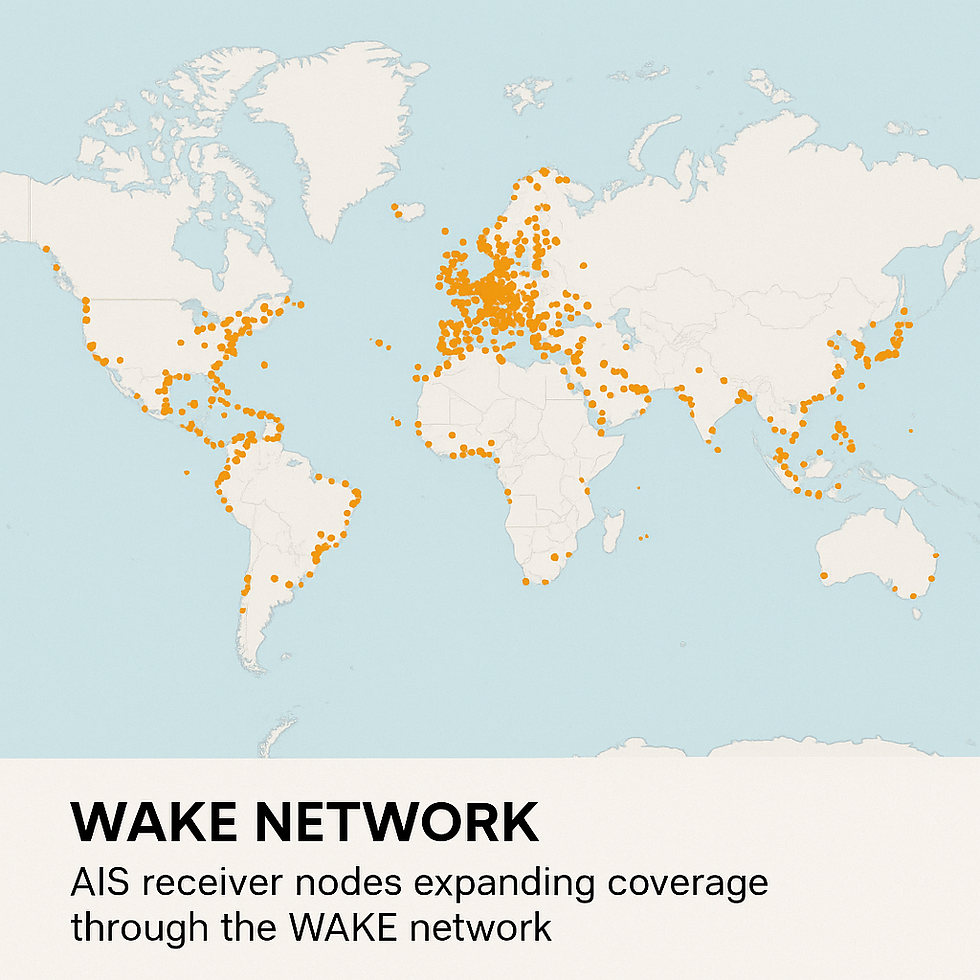
Spotlight: Worldwide AIS Network — Verified, Transpatrant, Independent Coverage
Worldwide AIS Network operates one of the most extensive independent terrestrial AIS receiver networks in the market. What distinguishes it from other providers is its focus on data verification, ensuring that AIS signals are authenticated and validated before being distributed to customers.
In a market where data integrity is increasingly important for sanctions compliance, emissions monitoring, and insurance underwriting, Worldwide AIS Network’s verification focused approach addresses a clear gap. Its broad station network delivers strong coastal coverage across major shipping lanes, positioning it as a credible primary or secondary source for organizations that require independently verified AIS data not controlled by Kpler or S&P Global.
For data buyers assessing their options, Worldwide AIS Network represents a proven and operational alternative, offering the level of data quality assurance that enterprise customers require.
Other Notable Independents
AAC Clyde Space has emerged as the most prominent remaining independent satellite AIS provider. Following Kpler’s acquisition of Spire Maritime, industry reports indicate that AAC Clyde Space experienced a significant increase in inbound interest from companies seeking satellite AIS alternatives. They operate their own satellite constellation and offer direct data feeds.
VesselFinder is the largest independent vessel tracking platform by user base, with approximately 7.7 million monthly visitors. While primarily known as a consumer-facing ship tracker, VesselFinder also offers enterprise data services and maintains a substantial terrestrial AIS network. Over half of its traffic comes from organic search, suggesting strong brand awareness and a user base that actively chooses it as an alternative to MarineTraffic.
How to Evaluate AIS Data Providers in a Consolidated Market
The evaluation criteria for AIS data providers have changed. Two years ago, the primary considerations were coverage, refresh rate, and price. Those still matter, but the consolidation wave has introduced structural risks that require new questions.
The following framework is specifically calibrated for the post-consolidation reality. It should be applied to every AIS data vendor evaluation, including renewals with existing providers.
The Post-Consolidation Evaluation Framework
Criterion | What to Ask | Why It Matters Now |
Ownership Independence | Is this provider privately held, publicly traded, or a subsidiary? Any pending acquisition interest? | Three major AIS providers were acquired in 24 months. Your next vendor could be next. |
Data Source Diversity | Terrestrial, satellite, or both? Single constellation or multi-source aggregation? | Single-source providers are single points of failure if terms change under new ownership. |
Refresh Rate & Latency | What is the satellite revisit time? Terrestrial update frequency? Historical data depth? | Ranges from 15-minute satellite passes to near-real-time terrestrial. Your use case determines what you need. |
Pricing & Terms Transparency | Is pricing published or quote-only? What are the data redistribution terms? Price lock guarantees? | Consolidation concentrates pricing power. Transparent, locked-in terms protect your budget. |
Vendor Redundancy | What happens to your product if this provider is acquired tomorrow? Can you switch in 30 days? | Companies that relied on Spire learned this lesson the hard way. Build redundancy before you need it. |
The Case for a Diversified Sourcing Strategy
The same logic that drives organizations to use multiple cloud providers, multiple payment processors, or multiple shipping carriers applies to AIS data. A vendor diversification strategy for maritime data is no longer a nice-to-have — it is a risk management necessity.
A practical diversification model might include: one consolidated provider (Kpler or S&P Global) for the breadth and reliability that scale provides, one independent commercial provider (AAC Clyde Space, VesselFinder or Worldwide AIS Network) for redundancy and price tension, and one structurally independent source (such as Mastchain’s decentralized network) for long-term resilience against further consolidation.
This three-source model ensures that no single acquisition, pricing change, or terms renegotiation can disrupt your data pipeline. It also provides natural benchmarks for data quality, freshness, and pricing across providers.
Your Next Contract Renewal Is a Strategic Decision
The AIS data market of 2024 no longer exists. Three acquisitions in 24 months created a near-duopoly that controls the majority of both terrestrial and satellite AIS collection infrastructure. The UK CMA is reviewing the competitive implications. Analytics companies that built products on independent data feeds face uncertain access and terms.
If you take only one action after reading this: audit your current AIS data supply chain before your next renewal. Know which of your providers are now subsidiaries of Kpler or S&P Global. Understand what that means for your pricing, your access terms, and your business continuity.
Then evaluate at least one independent alternative. The providers mapped in this article — from established independents like the Worldwide AIS Network, AAC Clyde Space, and VesselFinder to emerging decentralized models like Worldwide AIS Network — offer real options for organizations that want to reduce single-vendor dependency.
The window for proactive diversification is open. The question is not whether consolidation will affect your data costs and access — it already has. The question is whether you will build resilience before or after the next contract negotiation makes it urgent.


Comments